
Our tree moving technicians are trained in our patented processes and operate our tree spades that range from 65 inches to 168 inches. Large tree transplanting often requires the relocation of the tree for a period of time. Our tree boxing and relocation programs allow you to develop a construction schedule to meet the needs of your project.
Large trees
shape our landscape
and tell our story
Large trees have created memories and served as gathering places in years past. For over 40 years we have worked with our clients to develop large tree transplanting solutions that meet their needs. Every large tree is unique, and requires a detailed plan for transplanting or preserving the tree.
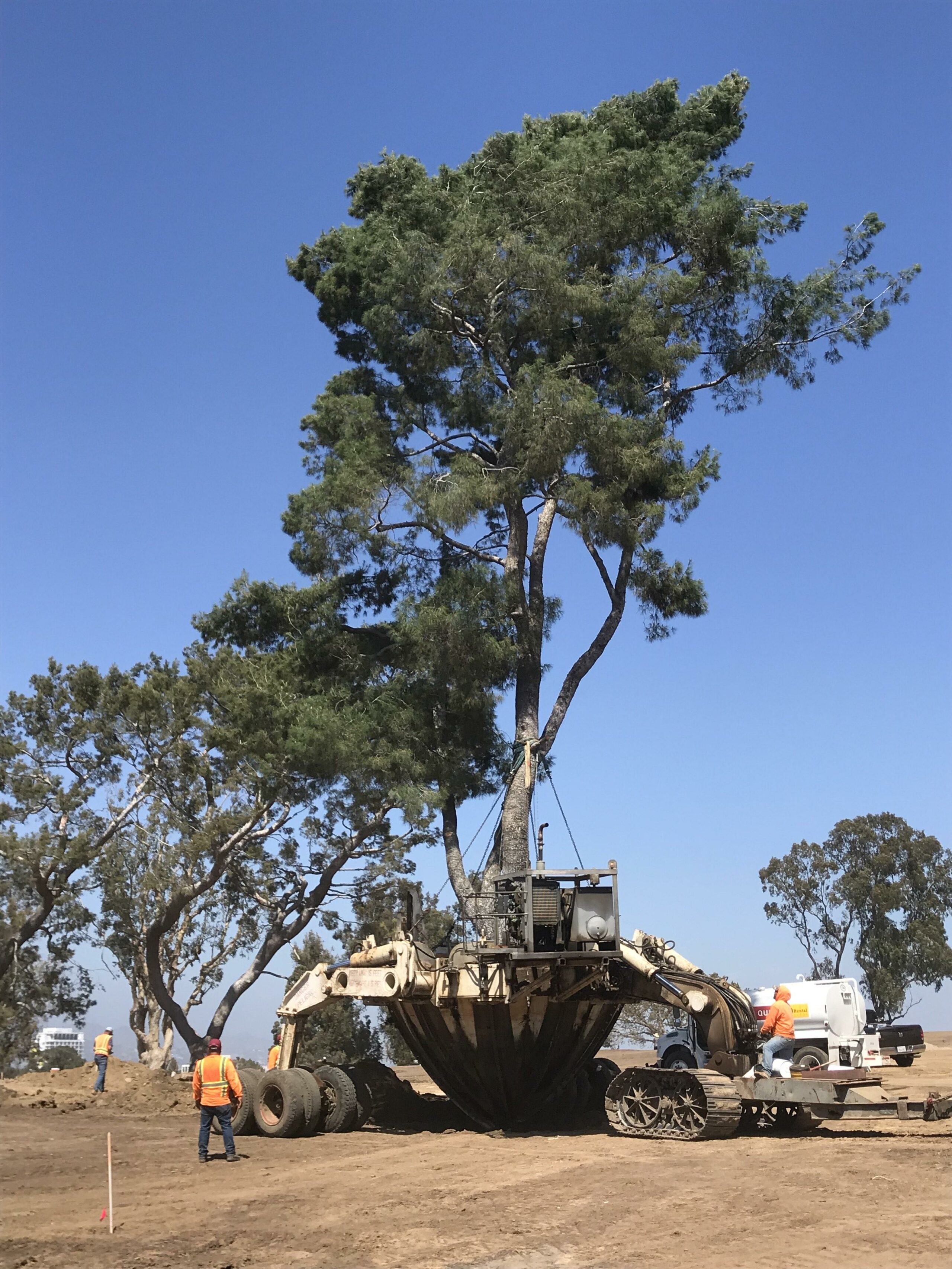
The largest tree spades in the world designed, built and patented by Environmental Design Inc.
We own and operate a fleet of hydraulic tree spades from 65 inches all the way to 168 inches. In addition, we have more experience and expertise in large tree transplanting than any tree transplanting company in the world. This is not limited to just the use of tree spades, but more advanced techniques for moving trees. Tree Spades still play an important part of our tree moving job day to day, and as such, we have devoted time and engineering into developing large tree spades for relocating truly enormous trees.
Tree Spade Patents:
Large Tree Transplanting & Tree Relocation
Looking for tree transplanting experts?
Environmental Design works with our clients and their designers to understand their vision to implement the best possible solution for the transplantation of large trees. By diligently working with our customers, we have been able to develop creative large tree transplanting solutions for our clients.
We have developed patented tools and processes such as ArborLift® that allow our experienced team of tree movers to design and implement large tree transplanting solutions. Our tree moving technicians are specifically trained in our patented processes and safely operate our tree spades and heavy equipment. Large tree transplanting often requires the relocation of the tree for a period of time.
Our tree boxing and relocation programs allow you to maintain a construction schedule to meet the needs of your project. Further, the trees themselves are excellently kept while in transport to ensure maximum vitality wherever it’s moved to.
Environmental Design is the industry leader when it comes to large tree transplanting and moving. Contact us today with your large tree transplanting needs. We will be glad to help you complete your vision for your landscape design project.
Contact Us Today To Transplant Your Mature Trees
Follow Us on Instagram
Large Tree Transplanting FAQs
How does a large tree relocation service support environmental design goals when transplanting mature and oversized trees on complex sites?
A large tree relocation service supports environmental design goals by preserving mature trees that provide immediate ecological, aesthetic, and functional value within redesigned landscapes. Rather than removing existing trees and starting over with new plantings, professional large tree movers make it possible to retain canopy cover, visual maturity, and environmental continuity while adapting a site to new uses.
Environmental design often involves regrading, infrastructure changes, or new construction that conflicts with existing tree locations. A specialized large tree moving service evaluates which trees can be successfully relocated and how they can be repositioned to enhance the final design. Mature tree relocation allows designers to frame spaces, define circulation areas, and establish focal points using living assets that already have scale and character.
Tree relocation contractors begin with a detailed assessment of tree health, root structure, and soil conditions. This evaluation determines whether big tree transplanting is viable and what preparation is required to maximize survival. Large specimen tree moving involves careful root ball sizing, canopy management, and timing to minimize transplant stress. These steps are especially important for heritage tree relocation, where preservation is often tied to regulatory or cultural considerations.
From a sustainability perspective, using a large tree relocation service reduces the environmental cost associated with tree removal, disposal, and replacement. Commercial tree relocation projects benefit from immediate shade, reduced heat island effect, and improved stormwater management. Corporate tree movers often integrate relocated trees into long-term landscape strategies that support branding, employee well-being, and community perception.
City tree transplant service projects also rely on professional expertise to maintain public safety and comply with municipal standards. By aligning arboriculture with design intent, a large tree relocation service transforms existing trees from obstacles into foundational elements of environmental design.
What types of projects benefit most from using a large tree relocation service instead of removing and replanting trees?
A large tree relocation service is most valuable on projects where mature trees contribute significantly to site value, identity, or environmental performance. The first sentence of effective tree preservation planning often applies to developments where time, scale, and visual impact matter, and where newly planted trees cannot deliver immediate results.
Commercial tree relocation is a common application. Office campuses, resorts, healthcare facilities, and mixed-use developments rely on established landscapes to create welcoming environments from day one. Professional large tree movers allow these projects to retain mature trees during expansion or redevelopment, avoiding the long establishment period associated with new plantings.
Municipal and civic projects also benefit from city tree-transplantation services. Road expansions, utility upgrades, and public space redesigns often require trees to be moved rather than removed. Tree relocation contractors working in these environments coordinate with engineers and planners to maintain safety, traffic flow, and regulatory compliance.
Heritage tree relocation is another critical use case. Properties with historically or culturally significant trees often face strict preservation requirements. Large specimen tree moving makes it possible to protect these assets while still accommodating new construction or site reconfiguration.
Corporate tree movers are frequently engaged for large-scale master planning efforts that span multiple phases or locations. Mature tree relocation provides continuity across development stages and reinforces sustainability commitments. Big tree transplanting also supports environmental mitigation strategies when tree removal is unavoidable elsewhere on a site.
In short, any project where mature trees are integral to environmental design, community perception, or regulatory compliance stands to benefit from a professional large tree relocation service.
How does a large tree relocation service evaluate tree health and site conditions before performing big tree transplanting?
A large tree relocation service evaluates tree health and site conditions through a comprehensive pre-transplant assessment designed to ensure long term survival and successful integration into the new landscape. This evaluation is a defining factor that separates professional large tree movers from standard tree services.
The process begins with a detailed health inspection. Tree relocation contractors examine canopy density, leaf quality, branch structure, and signs of disease or decay. Mature tree relocation requires that a tree has sufficient vigor to withstand root disturbance and relocation stress. Structural integrity is also assessed to confirm that the trunk and major limbs can tolerate lifting and transport.
Root system analysis is equally important. Large specimen tree moving depends on the ability to extract a viable root ball that contains enough fine roots to support recovery. Soil compaction, root depth, and root flare condition are evaluated to determine feasibility. For heritage tree relocation, this step is especially critical, as failure is not an acceptable outcome.
Site conditions at both the original and destination locations are analyzed. Professional large tree movers compare soil type, drainage, sun exposure, and available rooting space. Big tree transplanting into incompatible soil or restricted root zones can compromise long-term health, even if the move itself is successful.
Timing and logistics are also reviewed. Commercial tree relocation projects must align with construction schedules, seasonal dormancy, and equipment access. City tree transplant service projects may require additional coordination for permits, traffic control, or public safety.
By conducting thorough evaluations before any move, a large tree relocation service reduces risk, improves survival rates, and ensures that relocated trees enhance environmental design rather than becoming long term liabilities.
What specialized equipment and techniques are used by a large tree relocation service for large specimen tree moving?
A large tree relocation service relies on specialized equipment and advanced techniques to perform large specimen tree moving safely and effectively. The first sentence of any successful relocation involves matching the size and condition of the tree with the appropriate tools and methods.
Hydraulic tree spades are commonly used for mature tree relocation when soil conditions and tree size allow. These machines extract large, intact root balls that preserve critical feeder roots. For trees that exceed spade capacity, professional large tree movers use custom excavation methods combined with cranes and engineered lifting systems.
Cranes are essential for big tree transplanting involving extremely heavy or tall specimens. Tree relocation contractors calculate load distribution carefully to prevent damage to the trunk or root ball during lifting. Transport systems are designed to stabilize the tree and maintain moisture levels throughout the move.
Canopy management techniques reduce stress during relocation. Selective pruning lowers wind resistance and balances the tree with the reduced root mass, without compromising long-term structure. Large specimen tree moving also involves protective wrapping and root ball stabilization to prevent desiccation.
Commercial tree relocation and corporate tree movers operate in active environments where safety is critical. Equipment staging, controlled access zones, and coordination with site managers ensure that operations proceed without disrupting surrounding activities. City tree transplant service projects may also require additional measures for pedestrian and traffic safety.
By combining specialized equipment with expert technique, a large tree relocation service achieves results that protect both tree health and project integrity.
How does a large tree relocation service ensure long-term success after a mature tree relocation is completed?
A large tree relocation service ensures long term success by prioritizing post transplant care as an integral part of the relocation process. The first sentence of any enduring mature tree relocation outcome begins after the tree is placed in its new location, not when the equipment leaves the site.
Immediately following planting, professional large tree movers focus on stabilization. Anchoring systems are installed to prevent movement while roots re-establish. Soil is amended to improve structure, drainage, and nutrient availability, which is especially important for large specimen tree moving projects.
Irrigation planning is tailored to the species, soil, and climate. Tree relocation contractors develop watering schedules that support recovery without encouraging shallow root growth. For commercial tree relocation and corporate tree movers, these plans are often integrated into broader landscape maintenance programs.
Monitoring is ongoing. Professional large tree movers track canopy response, leaf production, and signs of stress over time. Early detection allows for corrective actions such as soil aeration, nutrient adjustments, or pest management. Heritage tree relocation projects may also require documentation and reporting to satisfy preservation standards.
City tree transplant service providers often coordinate with municipal maintenance teams to ensure continuity of care. Big tree transplanting success is measured not just in survival, but in long-term health and performance within the landscape.
Through structured aftercare and expert oversight, a large tree relocation service delivers lasting value, allowing transplanted trees to thrive as permanent, functional elements of environmental design.
How does a large tree relocation service support commercial and corporate developments that require mature landscapes on accelerated timelines?
A large tree relocation service supports commercial and corporate developments by delivering immediate landscape maturity that would otherwise take decades to achieve through new planting. The first sentence of many successful large-scale developments reflects the need for professional large tree movers who can align environmental design with aggressive construction and occupancy schedules.
Commercial tree relocation is especially valuable for office campuses, hospitality properties, healthcare facilities, and mixed-use developments where first impressions matter. Mature tree relocation provides instant canopy, shade, and visual presence that reinforces brand identity and enhances user experience from day one. Corporate tree movers work closely with developers and design teams to integrate relocated trees into site plans without delaying construction milestones.
Tree relocation contractors coordinate relocation activities with grading, utility installation, and building phases. This sequencing allows big tree transplanting to occur at optimal times, reducing conflicts and minimizing risk. Large specimen tree moving also supports sustainability objectives by preserving existing trees rather than relying solely on new plant material.
For corporate clients operating across multiple locations, consistency is critical. A large tree relocation service brings standardized processes, equipment, and expertise that can be applied nationwide. This ensures predictable outcomes regardless of site conditions or regional differences.
Post relocation care is equally important in commercial environments. Professional large tree movers implement monitoring and maintenance programs that protect the investment and ensure long term performance. By combining speed, precision, and biological expertise, a large tree relocation service enables commercial and corporate developments to open with landscapes that feel established, intentional, and environmentally responsible.
What role does a large tree relocation service play in city tree transplant service projects and public infrastructure improvements?
A large tree relocation service plays a vital role in city tree transplant service projects by preserving the urban canopy while allowing necessary infrastructure improvements to move forward. The first sentence of many successful public works projects reflects the value of professional large tree movers who can balance safety, compliance, and environmental stewardship.
Municipal projects such as road expansions, utility upgrades, transit corridors, and public space redesigns often require trees to be moved rather than removed. Tree relocation contractors collaborate with city planners, engineers, and public works departments to identify viable candidates for mature tree relocation and determine optimal new locations.
Urban environments present unique challenges. Limited access, overhead utilities, pedestrian traffic, and nearby structures require careful planning and specialized equipment. Large specimen trees moving in these settings demand precision and strict adherence to safety protocols. Professional large tree movers establish controlled work zones and coordinate closely with municipal authorities to minimize disruption.
Heritage tree relocation is particularly important in cities, where landmark trees often carry historical or cultural significance. A large tree relocation service documents processes, monitors tree health, and ensures compliance with preservation ordinances.
Beyond preservation, the city tree transplant service supports broader environmental goals. Mature trees improve air quality, reduce heat island effects, and enhance public spaces. By enabling big tree transplanting instead of removal, municipalities retain these benefits while modernizing infrastructure.
Through expertise and coordination, a large tree relocation service helps cities grow and evolve without sacrificing the urban forest that defines community character.
How does a large tree relocation service address risk management and liability during large specimen tree moving projects?
A large tree relocation service addresses risk management and liability through rigorous planning, professional execution, and strict safety protocols. The first sentence of any responsible large-scale relocation strategy involves understanding and mitigating risks to people, property, and the tree itself.
Tree relocation contractors begin by conducting site-specific risk assessments. This includes evaluating access routes, load-bearing surfaces, overhead obstructions, and proximity to buildings or utilities. Large specimen tree moving involves significant weight and height, making proper engineering and equipment selection essential.
Professional large tree movers are trained to handle complex lifts and transport operations. Cranes, transport vehicles, and rigging systems are selected and configured to match the tree’s size and structure. Big tree transplanting operations are carefully choreographed to reduce unexpected movement or stress.
Commercial tree relocation and corporate tree movers often work in active environments where employees, visitors, or residents are nearby. Safety zones, signage, and coordination with site managers ensure operations proceed without incident. City tree transplant service projects may require additional public safety measures, such as traffic control or temporary closures.
Insurance coverage and regulatory compliance are also key components. A reputable large tree relocation service carries appropriate insurance and adheres to local, state, and federal guidelines. Heritage tree relocation projects may involve additional documentation and oversight.
By proactively managing risk, professional large tree movers protect clients from liability while delivering reliable outcomes that support environmental design goals.
How does a large tree relocation service contribute to sustainability and long-term environmental performance in landscape design?
A large tree relocation service contributes to sustainability by preserving mature trees that provide immediate and measurable environmental benefits. The first sentence of sustainable landscape design often emphasizes retention over replacement, and professional large tree movers make this approach feasible.
Mature tree relocation preserves canopy cover that reduces heat island effects, improves air quality, and manages stormwater runoff. Big tree transplanting allows these benefits to continue uninterrupted, unlike new plantings that require years to reach functional maturity.
Tree relocation contractors also reduce waste. Removing and disposing of large trees generates significant debris and carbon emissions. Large specimen tree moving avoids these impacts while maintaining ecological continuity. Commercial tree relocation projects often leverage this approach to meet sustainability benchmarks and certification requirements.
Heritage tree relocation aligns environmental responsibility with cultural preservation. Retaining landmark trees reinforces community identity and demonstrates stewardship. Corporate tree movers often highlight these efforts as part of broader environmental, social, and governance initiatives.
City tree transplant service projects further extend sustainability benefits to public spaces, where mature trees enhance livability and resilience. Professional large tree movers ensure that relocated trees are positioned and cared for in ways that support long-term health.
By integrating arboriculture into environmental design, a large tree relocation service delivers sustainability outcomes that extend well beyond aesthetics, supporting healthier landscapes and communities.
When should developers and designers engage a large tree relocation service during environmental design and planning phases?
A large tree relocation service should be engaged as early as possible during environmental design and planning phases to maximize success and flexibility. The first sentence of an effective tree preservation strategy emphasizes early involvement rather than reactive solutions.
When professional large tree movers are consulted during conceptual design, they can identify which trees are viable candidates for mature tree relocation and how those trees can influence site layout. Tree relocation contractors provide critical input on spacing, soil preparation, and access requirements that shape design decisions.
Late engagement often limits options. Grading, utilities, or structural placements may make big tree transplanting impractical if not planned in advance. Large specimen tree moving benefits from alignment with construction sequencing and seasonal timing.
Commercial tree relocation and corporate tree movers add value by coordinating across disciplines. Their early involvement reduces conflicts, streamlines permitting, and supports sustainability goals. Heritage tree relocation projects particularly benefit from early planning to ensure compliance and community support.
City tree transplant service projects also rely on early coordination to manage public safety, traffic, and regulatory approvals. By engaging a large tree relocation service at the outset, project teams reduce risk, control costs, and unlock design opportunities that preserve mature landscapes while supporting development goals.